
Diversity In Life | Take A Quiz Test | Start
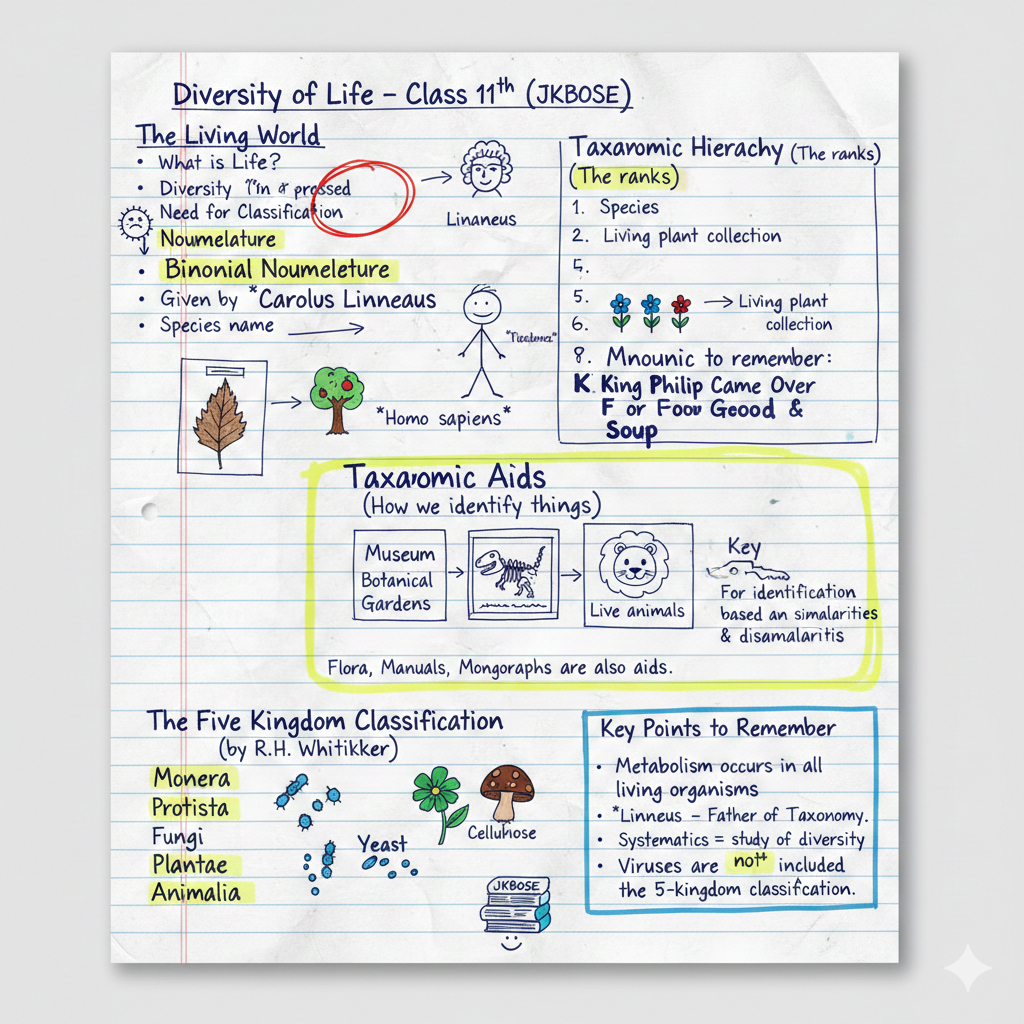
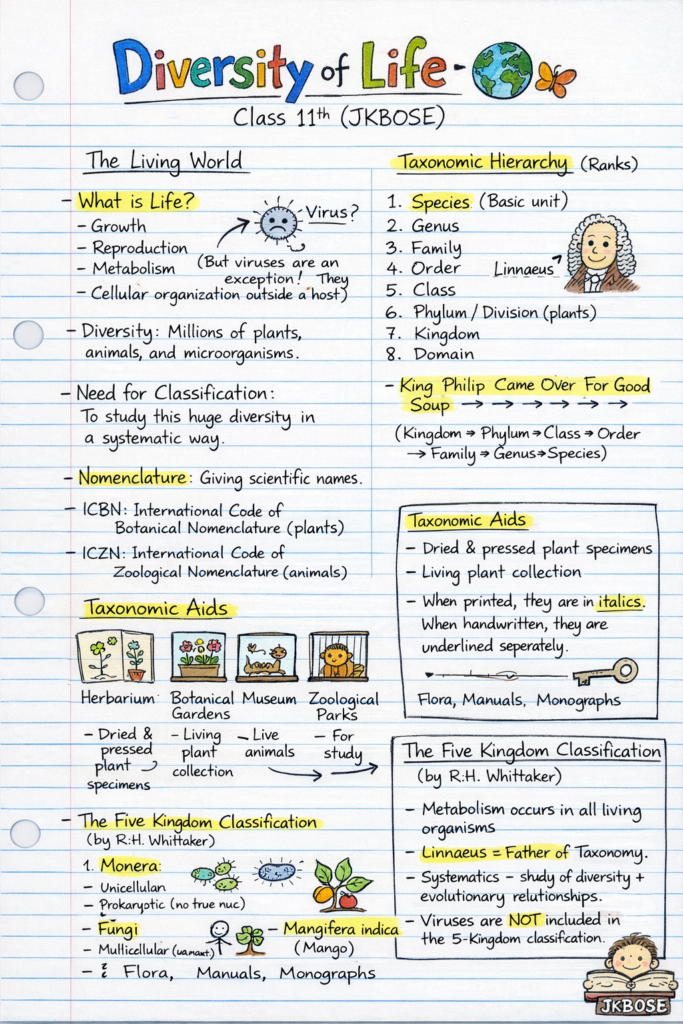
Chapter 1: The Living World (Diversity of Life)
1.1 What is Living?
Living organisms are not just a collection of molecules. They are distinct from non-living things because they possess certain key characteristics:
- Growth: Increase in mass or number of cells. In plants, growth continues throughout life; in animals, it occurs up to a certain age. However, growth is not a definitive characteristic because mountains and boulders also grow (by accumulation of material).
- Reproduction: The ability to produce offspring of their own kind. This is considered a very important characteristic of life. (Exception: Mules, worker bees, and infertile humans do not reproduce, yet they are living).
- Metabolism: The sum total of all chemical reactions occurring in the body. All living organisms have metabolism. No non-living object shows metabolism.
- Cellular Organization: All living beings are made up of cells, which are the basic structural and functional units of life.
- Consciousness: The ability to sense the environment and respond to stimuli. This is perhaps the most defining feature of life.
Key Point: Viruses are an exception. They show reproduction (inside a host) and have genetic material, but they lack metabolism. Therefore, they are considered to be on the borderline between living and non-living.
1.2 Diversity in the Living World
- Biodiversity: The term used to describe the immense variety of life forms on Earth, including plants, animals, fungi, and microorganisms.
- Estimated Numbers: Scientists have estimated that there are about 1.7–1.8 million known species, though many more (estimates range from 5 to 50 million) are yet to be discovered.
- The Challenge: Studying this huge variety of life forms is impossible without a proper system. This is where classification comes in.
1.3 Need for Classification
Classification is the process of grouping organisms based on their similarities and differences. It is necessary because:
- It makes the study of millions of organisms manageable.
- It helps in understanding the relationships between different groups of organisms.
- It provides a universal name for an organism, allowing scientists from all over the world to communicate without confusion.
1.4 Nomenclature (Scientific Naming)
Common names (like “dog” or “mango”) vary by region and language, causing confusion. To solve this, scientists use a standard system of naming.
- Binomial Nomenclature: Given by Carolus Linnaeus (Father of Taxonomy).
- The Rules:
- Every organism has a two-part name: The Genus and the Species.
- The genus name starts with a capital letter.
- The species name starts with a small letter.
- When printed, the name is written in italics. When handwritten, it is underlined separately.
- Examples:
- Homo sapiens (Humans)
- Mangifera indica (Mango)
- Felis domesticus (Cat)
- International Codes:
- ICBN: International Code of Botanical Nomenclature (for plants).
- ICZN: International Code of Zoological Nomenclature (for animals).
1.5 Taxonomic Hierarchy
This refers to the sequence of categories (ranks) in which organisms are classified, from the broadest to the most specific.
The 7 Main Obligate Categories:
- Kingdom: The highest and broadest category.
- Phylum (for animals) / Division (for plants)
- Class
- Order
- Family
- Genus: A group of related species.
- Species: The lowest and most basic unit. A group of organisms that can interbreed to produce fertile offspring.
Mnemonic to remember the order:
King Philip Came Over For Good Soup
(Kingdom → Phylum → Class → Order → Family → Genus → Species)
1.6 Taxonomic Aids (Tools for Identification)
These are the tools, techniques, and stored information that help in the identification and classification of organisms.
- Herbarium: A storehouse of collected plant specimens that are dried, pressed, and preserved on sheets. They are arranged according to a standard classification system.
- Botanical Gardens: Places where living plants are grown for reference and identification. (e.g., Royal Botanic Garden, Kew in England; Indian Botanic Garden, Howrah in India).
- Museum: Institutes that have collections of preserved plant and animal specimens for study and reference.
- Zoological Parks: Places where wild animals are kept in protected environments, allowing for the study of their behavior and food habits.
- Key: A taxonomical aid used for identification of plants and animals based on similarities and dissimilarities. Keys are based on contrasting characters generally in a pair called couplet.
1.7 The Five Kingdom Classification (By R.H. Whittaker)
In 1969, R.H. Whittaker proposed a system of classification that divides all organisms into five kingdoms based on three main criteria:
- Cell Structure: (Prokaryotic vs. Eukaryotic)
- Body Organization: (Unicellular vs. Multicellular)
- Mode of Nutrition: (Autotrophic vs. Heterotrophic)
| Kingdom | Cell Type | Body Organization | Mode of Nutrition | Examples |
|---|---|---|---|---|
| 1. Monera | Prokaryotic | Unicellular | Autotrophic (Chemosynthetic/ Photosynthetic) or Heterotrophic | Bacteria, Blue-green Algae (Cyanobacteria) |
| 2. Protista | Eukaryotic | Unicellular | Autotrophic (Photosynthetic) or Heterotrophic | Amoeba, Paramecium, Euglena, Diatoms |
| 3. Fungi | Eukaryotic | Multicellular (except Yeast) | Heterotrophic (Saprophytic/Parasitic) – Cell wall of Chitin | Mushrooms, Yeast, Penicillium, Aspergillus |
| 4. Plantae | Eukaryotic | Multicellular | Autotrophic (Photosynthetic) – Cell wall of Cellulose | Mosses, Ferns, Pine trees, Mango, Rose |
| 5. Animalia | Eukaryotic | Multicellular | Heterotrophic (Holozoic/Ingestive) – No cell wall | Sponges, Insects, Fish, Birds, Humans |
Summary of Key Terms
- Systematics: The study of diversity of organisms and their evolutionary relationships.
- Taxonomy: The science of naming, describing, and classifying organisms.
- Species: The basic unit of classification.
- Carolus Linnaeus: Known as the “Father of Systematic Botany” and developed the Binomial system of nomenclature.
- Viruses: Not included in the Five Kingdom classification.
Quiz Test
Correct:0
Wrong:0